
Market context, bounded autonomy, and decisions you can audit.
See the evidence and the safety gates before trusting a decision.
Athena combines a local market-research cockpit with a developing investor mobile preview. The research view tracks market context and risk; the preview displays a read-only brokerage snapshot and SHADOW-mode decision evidence. Brokerage execution is locked in the current build. Athena does not claim a validated stock-picking edge or promise returns.
Market backdrop, exposure, and research discipline in one place.
The existing local console brings together market regime, index data, supplied position-risk inputs, a trade journal, and research findings. Its screens below show that research cockpit. The mobile investor preview is a separate interface with explicit data origin and execution-state labels; its current brokerage account has no positions or orders.
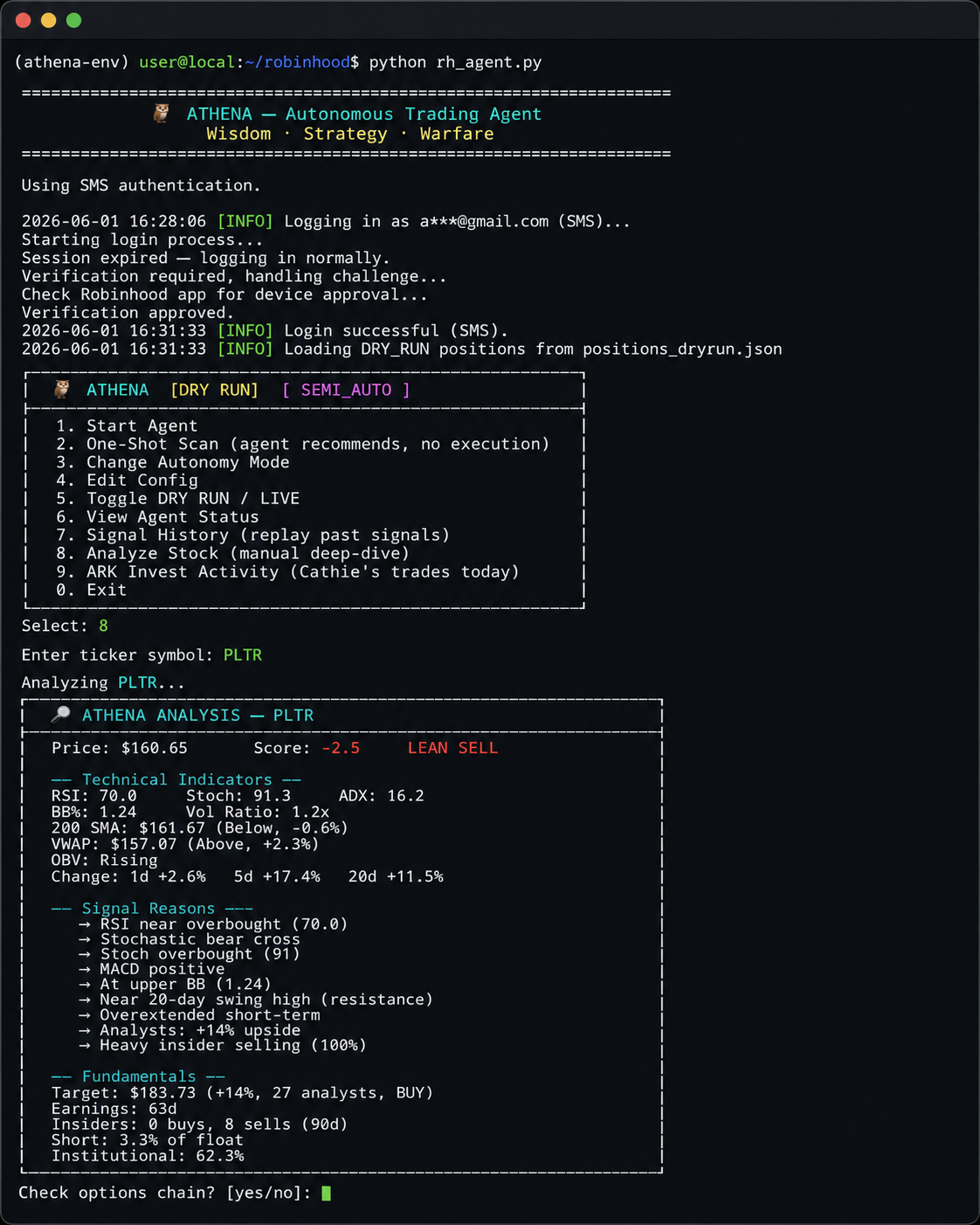
Existing local research console; this is not a screenshot of the current Robinhood account or mobile preview.
Brokerage facts and decision provenance, without an order path.
The Simple view gives a concise operating summary; Detailed opens the brokerage and autonomy audit evidence. The Robinhood connector uses a small allowlist of read-only tools. The app labels a snapshot by origin, account scope, capture time, and whether the server explicitly reports execution locked. If lock state is missing or reported unlocked, the interface warns instead of displaying a read-only reassurance.
Evidence before a verdict
A decision appears as current only when its stored capture ID and account scope match the displayed brokerage snapshot, its origin agrees, and its timestamp does not predate the capture. Older unlinked decisions remain in history.
Execution stays locked
The current preview operates in SHADOW mode. Brokerage execution is disabled, and APPROVAL and AUTO modes remain locked. A missing or unreadable status is shown as unavailable, not as an all-clear.
Verified development snapshot · September 26, 2026
One LIVE read-only capture was published for a masked Agentic account scope. It showed zero positions, zero orders, and zero quotes. No current shadow decision is linked to that capture, so the investor view reports no current decision. A historical synthetic decision is retained as history, never presented as the LIVE account's verdict.
This is a dated, supervised development result, not a continuously refreshed brokerage feed or a public trading service. Raw response captures are not included in the investor API response.
Understand the conditions before you take risk.
Athena tracks the macro backdrop — Treasury yields and the curve, real rates, volatility, the fiscal backdrop, and equity concentration — against commonly-cited thresholds, and summarizes it as a plain regime read. It draws on public Federal Reserve / Treasury data and market-price ratios computed from public price feeds.
Illustrative regime labels below; they are not today's market readings.
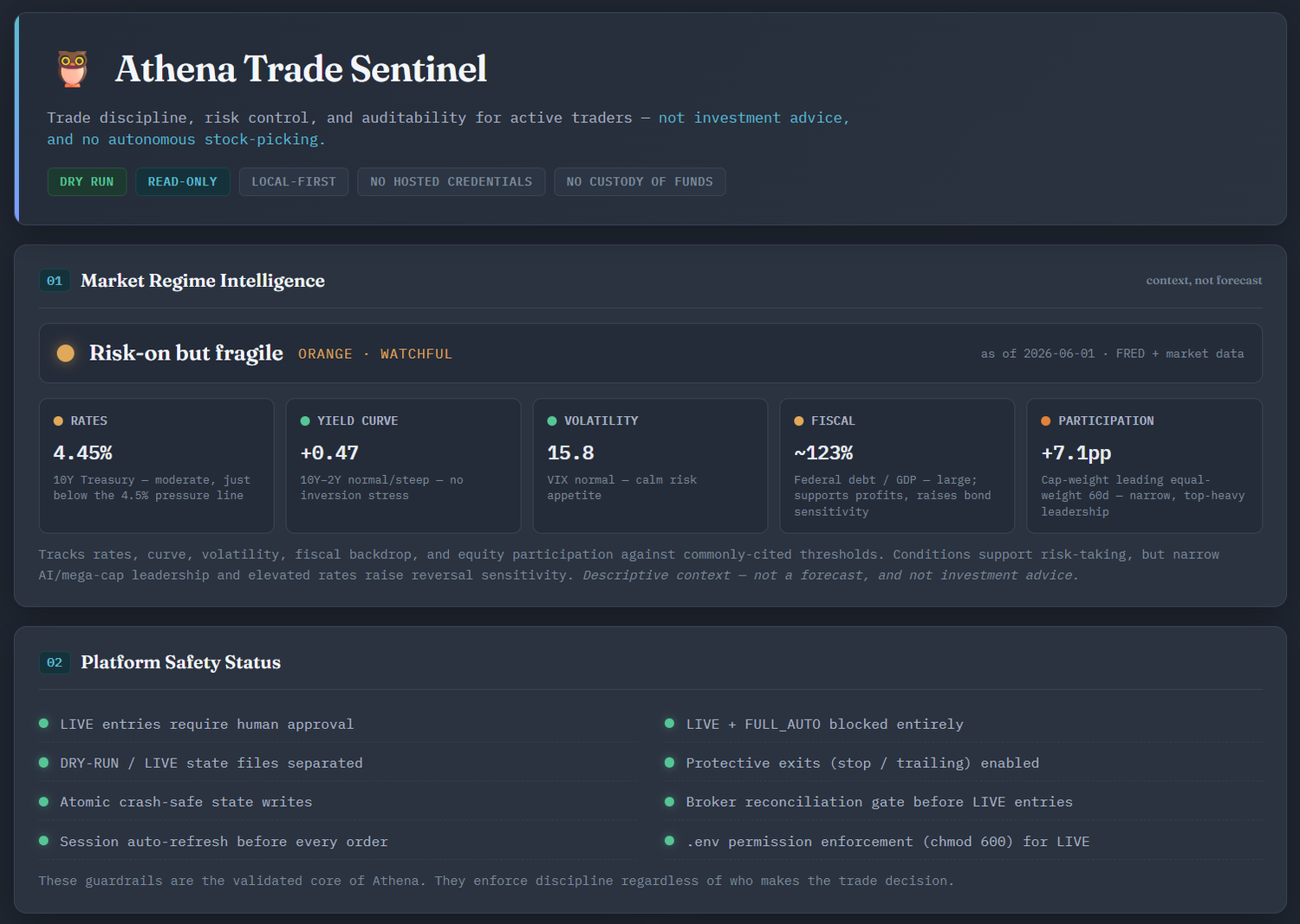
Example regime panel across rates, curve, volatility, fiscal, and equity participation.
The regime read describes conditions against standard thresholds. It is not a prediction of returns and not investment advice. The thresholds are descriptive market conventions, not validated forecast triggers.
See the context and model the risk when positions are supplied.
The local research console can display configured index and volatility feeds alongside position-risk plans. For a supplied position, it can calculate an ATR-based stop, trailing stop, take-profit level, and estimated dollar risk at stop. These are planning displays, not broker orders or guarantees that a stop will execute. The current read-only Robinhood capture has no positions to display.
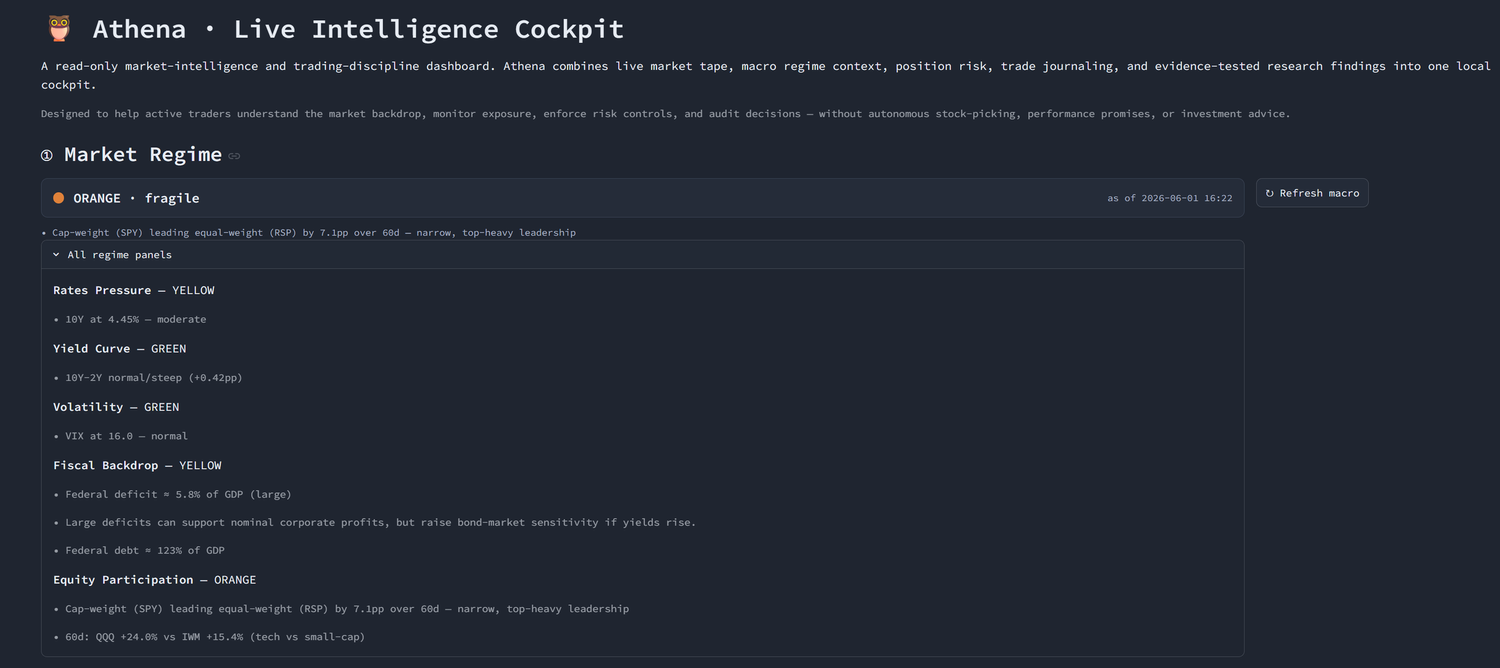
Earlier local console example; feed timeliness depends on the configured provider.
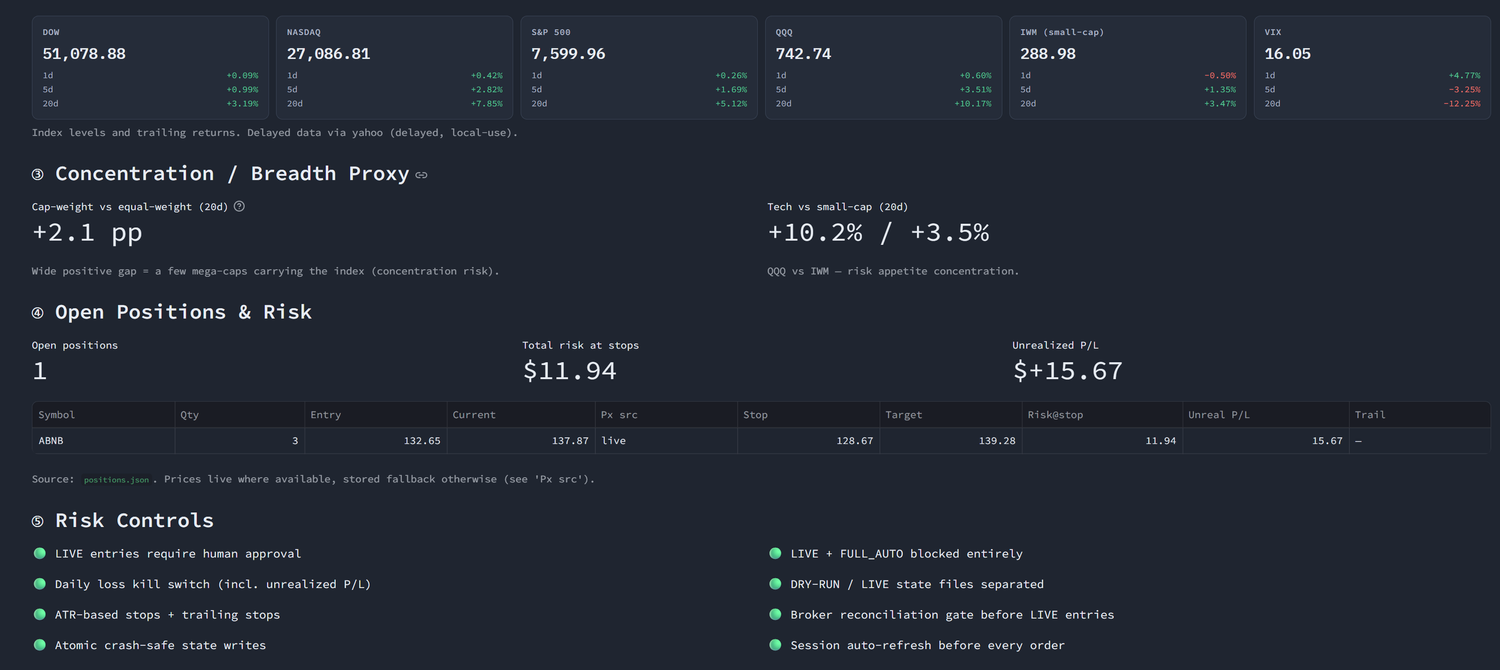
Sample position-risk planning screen; it does not depict the current empty Robinhood account.
Volatility-aware planning
ATR-based stop levels adapt the displayed risk plan to the name's volatility when the required inputs are available.
Trailing levels
A trailing level can ratchet upward in the model. The current read-only integration does not place or maintain broker stops.
Locked execution
The investor preview accepts no live entries: brokerage execution is disabled and the order path is unreachable in this build.
Visible assumptions
Dollar risk at a modeled stop depends on quantity and price. Missing inputs stay unknown instead of becoming invented exposure.
We test every claim the same way. We publish what fails and what holds.
Most trading products show you a winning backtest and hide the rest. We do the opposite: every claim goes through the kind of validation most tools avoid — point-in-time data with no look-ahead, out-of-sample testing across market regimes, and a strict pass/fail bar — and we publish the result whichever way it falls. The discipline to tell a real edge from noise is the product. Here is one claim we rejected and one we kept.
We tested whether Athena's daily technical signal engine could predict which stocks would outperform. It could not, and we stopped marketing it as one.
- Score census: no reliable relationship between the engine's signal score and forward returns.
- Machine-learning study: 0 of 9 model/target combinations passed a strict out-of-sample bar (validation and test, across split methods).
- Result: Athena is not a stock-picker, because the evidence didn't support the claim.
We then tested a different question: not which stocks to pick, but when to carry more or less risk. A rules-based macro-regime overlay — using only point-in-time public data (Treasury yields, the curve, the VIX, equity trend) and a 10-day confirmation filter — passed all five checks of a strict risk-adjusted verdict, across two time windows.
- Reduced max drawdown from roughly −55% to −30% in historical stress tests (2000–2026).
- Cut volatility by about a third, while keeping most of the market's long-run return.
- Improved risk-adjusted return (Calmar 0.25 vs 0.16; higher Sharpe and Sortino) in both the full and 2007–2026 windows.
- No single year carried the result, and it survived ±20% perturbation of every threshold.
| Metric (2000–2026) | Buy & hold (SPY) | Regime overlay |
|---|---|---|
| Max drawdown | −55.2% | −30.3% |
| Volatility | 19.3% | 13.3% |
| Calmar (return / drawdown) | 0.16 | 0.25 |
| Sharpe | 0.54 | 0.61 |
| Annual return (CAGR) | 8.9% | 7.5% |
The overlay gave up about 1.3 points of annual return to roughly halve the drawdown — a risk-reduction trade, not a return-boosting one.
| Threshold sensitivity | Calmar | Max DD | Beats benchmark? |
|---|---|---|---|
| Baseline thresholds | 0.25 | −30.3% | yes |
| All thresholds −20% | 0.23 | −30.3% | yes |
| All thresholds +20% | 0.24 | −32.4% | yes |
| VIX threshold only, ±20% | 0.24 | −30–32% | yes |
| Rate threshold only, −20% | 0.23 | −30.3% | yes |
The edge survived perturbing every hand-set threshold by ±20% — it is not an artifact of specific cutoffs. (It rests mostly on long-term equity trend, with yields and volatility as confirmation.)
This is directionally suggestive, not validated market-timing alpha. True regime transitions are rare — roughly five in 26 years — so the effective sample is small. Athena does not predict crashes, does not promise lower drawdowns, and does not beat the market. It is a risk-discipline overlay whose historical behavior reduced downside, tested as honestly as we know how.
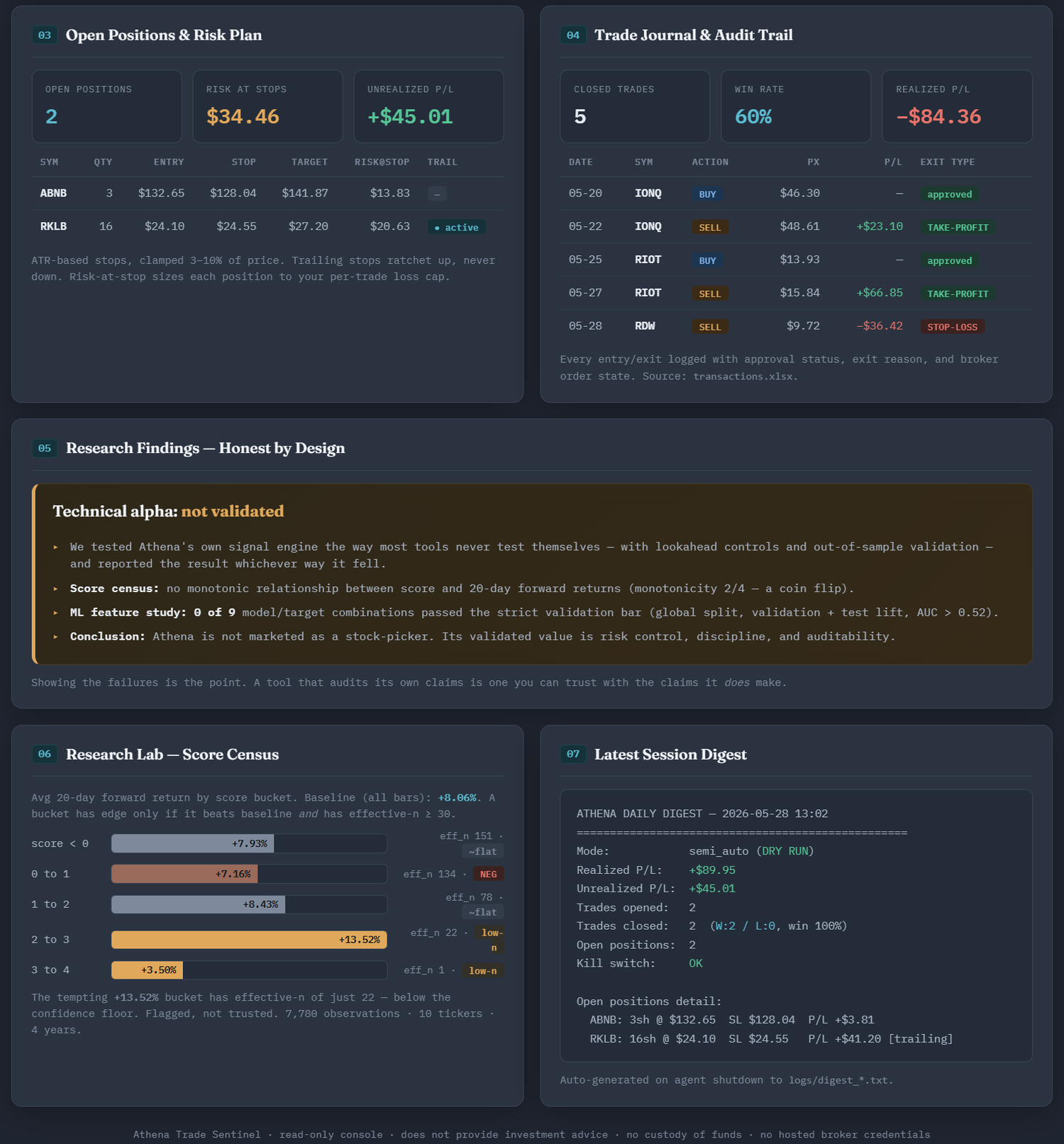
Research findings in the local console, including the rejected and the historically supported claims.
Keep a reviewable record of what the system observed and decided.
The local console includes a trade journal for activity recorded there. In the newer investor preview, autonomy checks and brokerage facts are displayed with their origin and operating mode. Stored shadow decisions remain available in history. The current-decision card stays empty until a decision explicitly links to the current capture and scope; it will not borrow an older synthetic ABSTAIN to fill the gap.
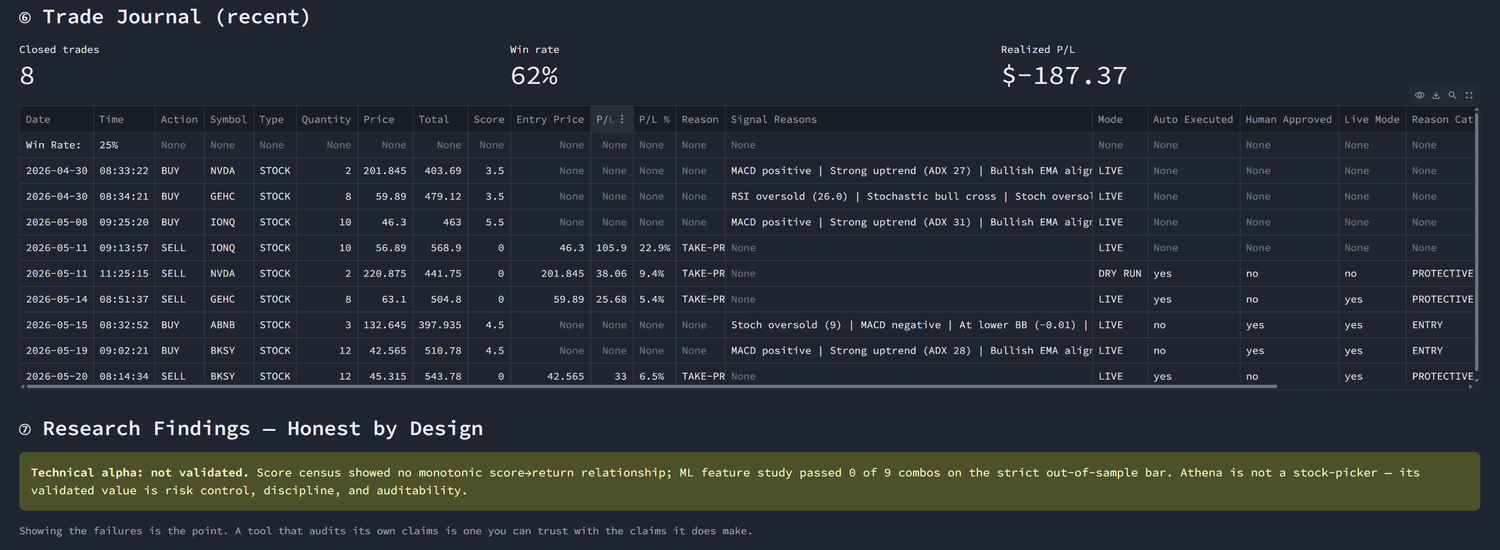
Earlier local-console journal and research screen; the current Robinhood snapshot contains no orders.
For investors who want context and traceable system behavior.
Self-directed investors
People who want market context and position-risk planning without treating a model's output as a recommendation.
Risk-conscious reviewers
People who want to see the lock state, data origin, and missing evidence alongside any displayed brokerage snapshot.
Evidence-minded builders
Teams studying bounded autonomy, explicit provenance, and an audit trail that separates historical records from current state.
What the preview can show, and what it cannot execute.
Read-only brokerage, SHADOW autonomy
Athena can show: market research from configured feeds, modeled risk, a dated read-only brokerage capture, explicit empty states, and audit evidence for shadow decisions. The mobile preview distinguishes a verified absence from a failed read.
In the current build: brokerage execution is disabled; no Robinhood order is reachable through this integration. APPROVAL and AUTO remain locked. The account in the verified capture is unfunded and has no positions or orders. No current decision has been linked to it.
Research results describe historical tests, not future returns. Athena does not recommend securities, take custody, or offer a public autonomous-trading service. Market-data timeliness depends on the configured provider.
Follow Athena's development
The investor mobile preview is being validated and is not a public trading product. If you care about evidence, clear limits, and inspectable financial software, we'd like to hear from you.
Get in touch →Athena is a research and discipline tool. It is not investment advice, a recommendation service, or a broker-dealer. Market data may be delayed depending on the configured provider.